
Ancient Greek Pottery Kraut

Ancient Greek Pottery Kraut

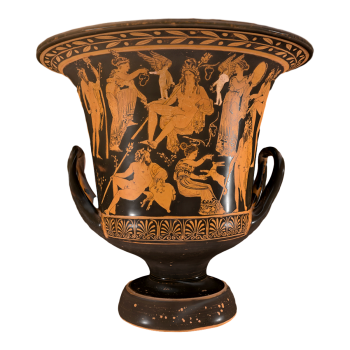
A Krater is a large pottery from ancient Greece, often used to mix wine and water. A kraut with a red patterned column refers to a column with a red pattern painted on the pottery. This pottery was made in the Camarina (Camarina) region of Sicily between about the 5th century BC and the 4th century BC. This Klatt style of decoration is known as the Red-figure style, which was very popular in ancient Greek pottery. The red painting style is characterized by the use of red paint to draw patterns on a black background, making the patterns more vivid and detailed.
Stamnos Pottery of Ancient Greece

Stamnos Pottery of Ancient Greece

Stamnos is a form of pottery common in ancient Greece and Rome, often used to hold wine or other liquids. This exhibit is now in the Museo Palazzo Corboli (Colbury Palace Museum).
3D model of bird beak spout spout pot replica

3D model of bird beak spout spout pot replica

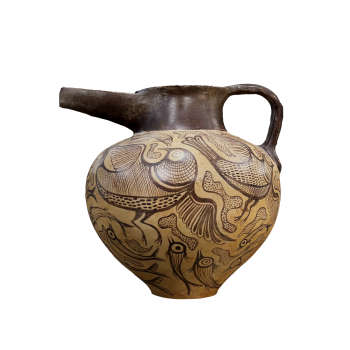
This type of pot was called "prochos" in ancient Greece, which is a container with a beak shaped spout. The original version can be traced back to the Late Minoan II to III period (1450 BC to 1100 BC). The design usually includes painted bird and fish patterns, which are decorative styles borrowed from the original works discovered on Crete. Not only does it hold an important position in ancient Greek culture, but it is also one of the representatives of ancient art and craftsmanship. It embodies the superb craftsmanship of ancient craftsmen, as well as their meticulous observation and expression of the natural world and animals.
Protoetic Amphora Ancient Greek Pottery - Metropolitan Museum of Art

Protoetic Amphora Ancient Greek Pottery - Metropolitan Museum of Art

It is an ancient Greek pottery, whose style originated in Athens in the 7th century BC and belongs to the early Attic period. The characteristic of this pottery is that it began to abandon abstract geometric patterns and instead adopted a naturalistic style influenced by Near Eastern art. Common decorative themes include Greek mythological scenes, animal and floral patterns. It is currently housed in the Metropolitan Museum of Art. This work depicts the battle scene between Hercules and the centaur Nessus. Hercules holds a sword and is grabbing the hair of Nessus, who is attempting to kidnap his wife Daenera. The artistic expression of pottery during this period was innovative and of great cultural and historical significance.
Attic Red Painted Pottery Box - National Museum of Athens

Attic Red Painted Pottery Box - National Museum of Athens

Depicting Leto on Delos Island, preparing to give birth to Apollo and Artemis. Originating from Eretria in the 4th century BC, it is currently housed in the National Museum of Athens. It is an ancient Greek ceramic container commonly used to store jewelry, cosmetics, or other small items. The characteristic is that its surface is decorated with a red painting style, which fills the black outline of the pottery with red, while the rest of the pottery retains its natural color or is painted black. The red painting style developed between the late 6th century BC and the 5th century BC, replacing the early black painting style.
Ancient Greek Red Statue Pottery - Igleio Archaeological Museum

Ancient Greek Red Statue Pottery - Igleio Archaeological Museum

It is a decorative style of ancient Greek pottery that replaced the early black figure pottery style in the 5th century BC. The characteristic of red pottery is that the background is painted black, while the characters and details are retained in the red color of the pottery. This technique makes the picture more vivid and three-dimensional. It is a red clay jar from the Kamarina site. This type of pottery jar was used in ancient Greece as a container for mixing water and wine, and its design typically included a wide bottom, a short neck, and two low circular handles. It is currently housed in the Igleio Archaeological Museum in Ragusa. This pottery is an important witness to ancient Greek culture and history.
Ancient Greek Red Pottery Vase - Yibelo Archaeological Museum

Ancient Greek Red Pottery Vase - Yibelo Archaeological Museum

It is an ancient Greek pottery named after its red background and black patterns. The red painted pottery vase unearthed in Camarina, Sicily, is a product of the classical period (5th century BC) and is currently housed in the Ibero Archaeological Museum in Ragusa, Italy. This kind of pottery bottle is usually used to contain oil or perfume, as burial objects at funerals, and also used in religious ceremonies. The bottle depicts a four horse chariot, which is a type of chariot pulled by four horses and commonly seen in ancient Greek mythology and art works. This demonstrates the ancient Greeks' emphasis on war and sports, as well as their worship and artistic expression of mythological stories.
Ancient Greek Black Statue Pottery Bottle - Ibero Archaeological Museum

Ancient Greek Black Statue Pottery Bottle - Ibero Archaeological Museum

It is an ancient Greek pottery characterized by patterns painted with black pigment on the surface of the pottery, with a white background. The black statue pottery vase unearthed at the Kamarina site is from Ragusa, Sicily, Italy. It belongs to the classical period and was made around the 5th century BC. Currently housed in the Ibero Archaeological Museum in Ragusa. The decorative style reflects the characteristics of ancient Greek black pottery, which is to draw black patterns on a white background. It reflects the ancient Greeks' pursuit of beauty and their worship of mythological stories. It showcases the superb craftsmanship of ancient Greek pottery making and provides us with valuable materials for studying ancient Greek culture and art.
Alabasteron Ancient Greek Pottery - Paul Getty Museum

Alabasteron Ancient Greek Pottery - Paul Getty Museum

It is a type of ancient Greek pottery, named after the Greek word "ἄλαβ στρον", referring to an elongated container with a rounded bottom and a lid at the mouth. The name and shape may originate from Egypt and have the same name as the stone used to make this container. It is usually used to store oils, especially perfume used by women after bathing. This specific Alabasteron was produced in the Attica region and can be traced back to 490 to 470 BC. The scene depicted on the container is a person holding a bow and arrow and an axe, with palm trees in the background. Currently housed in the Paul Getty Museum. It is an important cultural relic for studying the daily life and artistic style of ancient Greece.
Collins Bowl - Bonn University Academic Art Museum

Collins Bowl - Bonn University Academic Art Museum

The Corinthian bowl collected by the Academic Art Museum of the University of Bonn is an ancient Greek pottery dating back to around 575 BC, representing the pinnacle of pottery production during the Corinthian period. The excavation location of this bowl is unknown, but its exquisite craftsmanship and decoration showcase the superb skills of ancient Greek potters. The bowl wall is very thin, the bottom is low, the belly is spherical, the mouth edge is noticeably outward sloping, and there are handles installed horizontally on both sides. The bowl is adorned with a circular decorative strip, with two to three groups of warriors depicted on one side and riders galloping to the left on the other side. These patterns not only beautify pottery, but also reflect the wars, myths, and nature worship of ancient Greek society
Collins style wine jug - Academic Art Museum of Bonn University
Collins style wine jug - Academic Art Museum of Bonn University

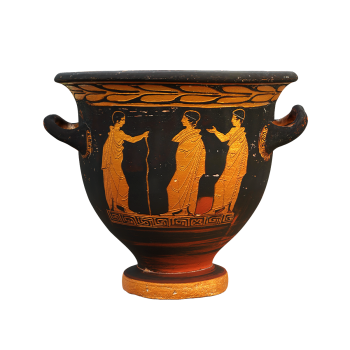
A Corinthian wine jug, collected at the Academic Art Museum of the University of Bonn, is a pottery piece produced in Corinth between 625 BC and 600 BC. Collins was a leader in pottery production at that time, and its products were widely exported throughout the Mediterranean region. The specific location where this pottery was unearthed is unknown. It is a pot with a three leaf shaped mouth edge and a sometimes upturned strap handle, which connects the mouth edge and shoulder. The black painting technique invented by Collins was used for drawing. It is an important type of ancient Greek pottery, and its design and decorative style reflect the prosperity of Greek culture and art.
Attic Red Pottery Bottle - Bonn University Art Museum

Attic Red Pottery Bottle - Bonn University Art Museum

It is a masterpiece of ancient Greek pottery art, currently housed in the Bonn University Art Museum. Known for its unique shape and decorative style, it is characterized by patterns drawn with black or dark brown pigments on reddish brown clay, creating sharp contrasts. It usually has a wide mouth rim and a downward contracting neck, shaped like an inverted bell, hence the name "Bell Ceramic Bottle". In ancient Greece, it was widely used to mix water and wine, and was an indispensable container for banquets and social events. The patterns on the bottle usually depict mythological stories, daily life scenes, or animals, and these intricate paintings showcase the superb skills of ancient Greek artists.
White bottomed Lequitos bottle

White bottomed Lequitos bottle

It is an ancient Greek pottery collected in the Academic Art Museum of the University of Bonn in Germany. It can be traced back to 50-460 BC and was likely made in the workshop of Thanatos painter in Athens. It is a container with a narrow body and a handle connecting the shoulders and neck, with the lid unfolding outward. This collection belongs to the Shoulder Legitos Bottle Group, a type of bottle produced since the mid-5th century BC. There is a naked young man painted on the bottle, holding a piece of wood, a stone, and a clock hanging above his left arm, chasing a wild rabbit on the hillside.
Bonn University Academic Art Museum Ancient Greek Pottery
Bonn University Academic Art Museum Ancient Greek Pottery

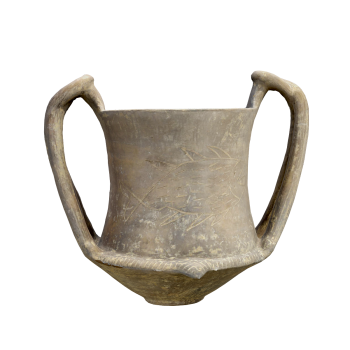
A piece of ancient Greek pottery collected in the Academic Art Museum of Bonn University. This bowl is said to have been discovered at the Diplon Gate in Athens, around 750 BC to 735 BC, and was produced in the Attica region. This vessel is characterized by steep edges and a horizontal band like handle. The upper wall is divided into panels with stars, Capricorn, swastika, and checkerboard patterns. The wide stripes between the handles are divided into three panels: a display zigzag band in the middle and birds on both sides. The handle itself is also decorated with a zigzag band. It is an outstanding representative of ancient Greek pottery art and an important physical evidence for studying ancient Greek culture and artistic style
Cantalos Ancient Greek Wine Cup

Cantalos Ancient Greek Wine Cup

It is a drinking cup from ancient Greece and is currently housed in the Academic Art Museum of Bonn University. Discovered in a tomb in Falerii Veteres, dating back to the mid-7th century BC to the latter half of the year, made of brownish red coarse clay. The cup body is concave and cylindrical, and the handle is arched and higher than the cup mouth. The bottom is separated from the cup wall by a circular coil, which displays vertical scratches and decorative knobs. There is a fish scratched on each side of the cup wall of the container. Not only is it an example of ancient Greek drinking culture, but it is also an outstanding representative of ancient Greek pottery art.
Laconia Kilix Cup

Laconia Kilix Cup

It is an ancient Greek pottery collected in the Academic Art Museum of Bonn University. Made between 550 BC and 530 BC, originating from the ancient Laconia region where Sparta was located. Known for its white coating and decorations concentrated on the inside of the bowl. The outer side of the cup presents a beam of light and several dark stripes of different widths. The inside displays a scene depicting two bearded, naked men talking. The smaller man on the left has a long beard and holds a Cantalos in one hand. The larger man on the right has a short beard and is not carrying any items. The blank space around the man is filled with bird and floral elements
Pelica Pelike - πελίんη "Ancient Greek pottery

Pelica Pelike - πελίんη "Ancient Greek pottery

Pelica Pelike - πελίκη "is an ancient Greek pottery produced in the Attica region, dating back to approximately 450 BC. This type of pottery is characterized by its maximum diameter at the bottom, which has a protruding "belly" for storing liquids. This special pottery belongs to the painter Carlshure and features a scene where a Satilus (the god of the forest) is chasing a Bacchus (a female follower of the god of wine) holding a torch in self-defense, with a female figure near the basket. Currently housed in the Metropolitan Museum of Art in New York.
Prototype Geometric Lequitos Bottle

Prototype Geometric Lequitos Bottle

It is an ancient Greek pottery, collected in the Academic Art Museum of Bonn University. This Lechitos bottle can be traced back to the prototype geometry period of the 9th century BC and was made in the Athens region. Known for its simple geometric patterns and decorative style, these patterns typically include lines, circles, and simple shapes. As a typical representative of this period, it showcases the skills and artistic aesthetics of ancient Greek ceramic artists. These pottery bottles are not only practical containers, but also valuable materials for studying ancient Greek culture and religious customs.
A large ancient Greek pottery basin painted with a Dionysus scene

A large ancient Greek pottery basin painted with a Dionysus scene

It is a large terracotta basin commonly used for mixing wine and can be used for banquets and religious ceremonies. It is made of red terracotta with black and red painted decoration. The Dionysus painted on the basin is the god of wine and drama in ancient Greek mythology, and is considered a symbol of joy, indulgence and banquets. The scenes on the pottery basin usually depict banquets associated with Dionysus, the entourage of the god of wine (also known as Cerenos), and other related mythological scenes. This pottery basin is usually handmade by a potter. It is used as a drinking vessel in feasts and celebrations, and may also be used in religious ceremonies and sacrifices.